Module 1: Starting Your FAFSA Application
A little preparation goes a long way!
Gather what you need, know your deadlines, and set yourself up for a smoother financial aid experience.
Know which form applies to you (FAFSA or TASFA).
Gather required documents: your Social Security Number, your parent(s)’ tax return (two years prior), driver’s license, and list of schools.
Tip: You can list up to 20 schools on the new FAFSA (previously only 10) — and you should.
Many students list only one or two schools because they think that’s where they’ll attend, but plans can change. You might not get accepted, you might change your mind, or you may decide on a different college in the summer. If that school wasn’t listed on your FAFSA, your financial aid won’t be sent there — which can delay your grants from being processed or disbursed. Listing more schools now prevents delays later, especially during August when campuses are busiest. It’s much better to list any school you’re even considering than to add it last-minute and risk your aid arriving late.Apply early—some aid is first-come, first-served
Many colleges have priority deadlines (e.g., Jan 15, Feb 1)—applying late might mean less aid.
Example:
If the FAFSA opens October 1 and you wait until March, you may miss out on state grants or school-based aid that already ran out
Keep in Mind: Each application covers the next academic year. For example, if you’re a senior in high school, you’ll apply starting October 1 to receive aid for your first year of college — typically Fall 2026 and Spring 2027. Submitting early helps ensure your aid is ready before classes begin.
Action Step: Create a secure folder or document to store all your login credentials.
Recap:
Apply every year you’re in college
Aid is split by semester (e.g., half in fall, half in spring)
Aid comes in 3 types:
🟢 Grants (free money)
🟡 Work-Study (paid part-time job)
🔴 Loans (you repay later—some with interest)

Preparation is the key to confidence. The more you organize now, the smoother your journey will be.
FAFSA TIMELINE:
October - FAFSA opens —> Jan/Feb - Priority deadlines —> March/April - Aid award letters sent —> Fall - Money disbursed
What to Expect When Filling Out the FAFSA
Take a moment to review what each section of the Free Application for Federal Student Aid (FAFSA®) (or Texas Application for State Financial Aid (TASFA), if applicable) covers. Understanding each step helps you complete your form accurately and on-time.
-
Verify your personal information (name, SSN/A-number, address) and state of residence so your form starts on the right foot.
-
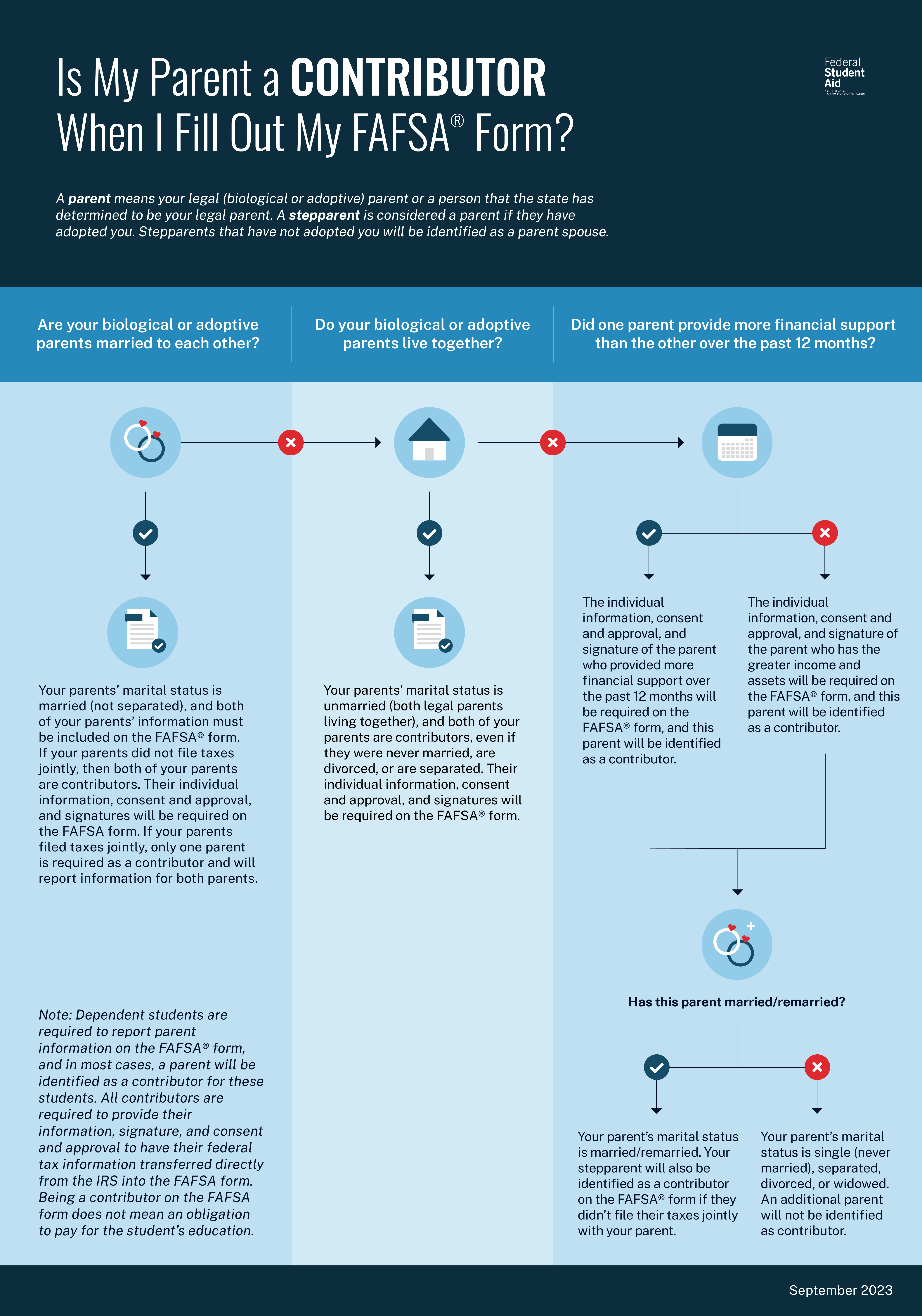
Answer questions about your dependency status, family, and special situations so you know whether you must include parent or guardian information.
Some students face unusual circumstances that may allow their Free Application for Federal Student Aid (FAFSA) to be processed without parent financial information. Examples include parental incarceration, abandonment, human-trafficking victim status, or refugee/asylee status.
-
Provide background information (citizenship, parent education, high school status) that doesn’t affect your aid but must be accurate for processing.
-
Enter income, tax, savings and asset details (for you and/or your parents) so your eligibility can be correctly calculated.
-
Select up to 20 (in most cases) schools to receive your information so they can build your financial aid package.
-
If required, invite your parent(s) or spouse to complete their section; each contributor needs their own StudentAid.gov account.
-
Review all your answers carefully and submit your form; this step finalizes your application and triggers the processing.
For more detailed guidance, visuals, and video tutorials, visit the official FAFSA® “Steps for Students” page.
Disclaimer: The information provided in this section is adapted from publicly available resources on the official Federal Student Aid (studentaid.gov) website. While every effort has been made to ensure accuracy and clarity, FAFSA® requirements and processes may change. Students and families are encouraged to visit the official website for the most up-to-date information.
-
Add a short summary or a list of helpful resources here.